
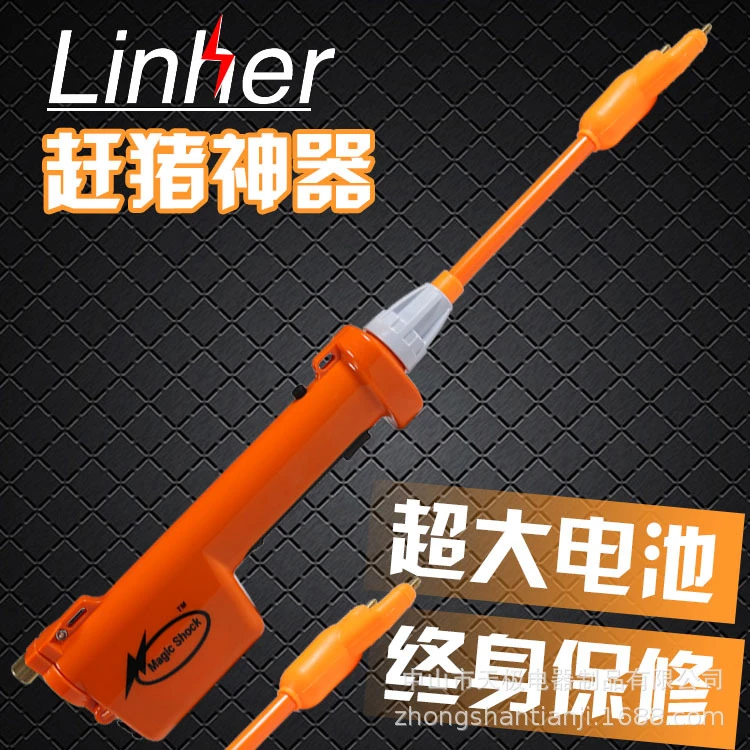
What is the A380C illuminated electric livestock prod: how it assists farms in driving cattle
The A380C is a handheld tool used on farms to assist in driving livestock such as cattle; it uses rechargeable power and has a light at the front end of the shaft. Its role is not to "push" or "pull" cattle, but to create a directional cue through sound, light, and approach movements that encourages cattle to move forward, helping personnel guide cattle to designated locations during tasks such as regrouping, loading, and medical treatment. Understanding this point is crucial: it is an auxiliary tool, and the actual effect depends on the passage structure, the condition of the cattle, and the operator's positioning, rather than on the equipment alone.
Illumination and rechargeable design: what on-site problems do they each solve?
Illumination solves the problem of "being able to see." During nighttime regrouping, in cattle shed passages with insufficient lighting, or in backlit areas of loading platforms, personnel often cannot clearly see where the cattle are stepping or the obstacles ahead, which affects the pace of guiding and increases the risk of being stepped on or bumped into. The light at the front of the shaft allows the operator to clearly see a short stretch of ground ahead of the cattle, making the guiding direction more accurate.
The cordless design solves the problem of "being usable anywhere." Pasture work sites are scattered, and cattle barns, exercise yards, and loading and unloading areas may not all have a nearby power source. The cordless design eliminates the constraint of dragging cables; simply charge it according to the shift schedule before use and take it with you.
The trade-off is that charging arrangements need to be planned in advance—if there is continuous high-intensity use for multiple days and the charging conditions cannot keep up, battery life will become a limitation. Before purchasing, this point should be confirmed with the manufacturer regarding actual usage time and charging cycle.
Why are there four rod lengths—35/56/66/82 cm—instead of just one?
The difference in rod length corresponds to the operating distance, not "the bigger the better." Short rods are held close to the body and are suitable for scenarios such as veterinary treatment and hoof trimming that require close-range restriction of cattle movement, allowing more precise movements;Long rods keep the operator farther away from the cattle and are suitable for tasks with long operating distances and where cattle are likely to resist, such as loading, unloading, and moving herds through wide passages, making personnel positioning safer. With only one length, you either find it bulky in close-range scenarios or unable to reach in long-distance scenarios, forcing you to compensate with your stance, which actually increases risk.
Having four lengths coexist essentially lets the on-site structure decide the "human-cattle distance": narrow passages and the need for fine control favor shorter lengths;wide passages and restless cattle favor longer lengths. The specific trade-off between 35 and 56 involves passage width, cattle body size, and operating habits; this belongs to the selection question in the next section and is not covered here.
It should be noted that rod length selection is interrelated with lighting and charging arrangements: long rods place higher demands on lighting direction during nighttime work, while short rods rely more on the operator's feel during close-range handling. Before purchasing, it is recommended to clearly list the actual working scenarios (day/night, passage width, duration of a single operation), then confirm with the current website team whether the corresponding rod length and configuration match, to avoid ordering based solely on length while ignoring usage conditions.
35cm or 82cm for cattle driving?Walk through the decision tree based on working distance, livestock species, and pen structure
35cm and 82cm are not the difference between "a bit shorter" and "a bit longer"; they are two working postures: the short rod lets you get close to the cattle and make fine movements;the long rod lets you stand outside the cattle's range of activity, trading distance for safety. The cost of choosing wrong is very concrete—the short rod can't reach, forcing the person to lean forward;the long rod can't turn around in a narrow passage, and instead startles the cattle.
Step one: first determine the working distance and personnel positioning needs
Ask yourself one question: during operation, on which side of the cattle do you want the person to stand?
- Must get close to the cattle and perform fine hand movements(such as veterinary treatment, restricting cattle movement during hoof trimming, local guidance), 35cm is handier; the rod body does not drag on the ground or catch on the rails.
- The operator needs to stand outside the range of the cattle's kicking.(For example, when cattle resist loading during loading, or when driving restless cattle in the chute), 56cm or 66cm is the middle range, balancing control and a safe distance.
- When the work point is clearly far from the operator and direction needs to be guided across a small gap(such as in a wide chute or around the perimeter of the loading area), 82cm is more suitable, but only if there are no low horizontal bars or dense uprights nearby.
Note: no specific distance values are inferred here, because at the same distance, the cattle's restlessness and slippery ground conditions will change the actual standing position. You only need to judge whether the operator needs to step back noticeably.
Step two: then check whether the pen, chute, and vehicle structure allow long-rod operation.
Whether the rod length can be used depends on whether there is space on site for the rod to swing freely:
- Narrow passages, dense neck clamps, low fences: Long poles easily hit the rails or are forced to be held at an angle, deforming the operation; in this case, 35cm or 56cm is more practical.
- Loading and unloading platforms, spacious staging areas, open pens: 82cm has room to perform, and with the A380C's lighting function, you can clearly see the cattle's forward movement even in low light.
- Inside vehicle compartments: Space is limited; be cautious with 66cm and above, and first confirm whether turning maneuvers can be completed inside the compartment.
If the site structure is complex, with both narrow passages and loading areas, there is no need to force one pole to handle everything—choose the main pole length based on the primary work scenario, then confirm with the team whether other specifications need to be paired.
Conclusion boundaries
35cm is suitable for close-up fine operations, 82cm is suitable for driving scenarios that require a pulled-back stance and where space allows, and 56cm and 66cm are intermediate transitional options. Which option to ultimately choose depends on whether your main work scenario is "close-up" or "pulled-back," and whether the pen provides enough room for the long pole to move. If you are unsure, tell the team the aisle width, common work points, and how restless the cattle are, and they will help you confirm the matching specification.
Whether lighting and rechargeable operation are really worth it: the trade-offs for nighttime herd moving and farms without a fixed power supply
Here is the judgment first:Lighting and rechargeable operation are not mandatory options, but optional capabilities determined by "working hours" and "power conditions." For cattle farms that move herds during the day and have fixed lighting in the aisles, an ordinary pig-driving stick is enough;only if you often move herds in the dark or the pasture cannot run fixed electrical wiring are these two capabilities worth adding.
When driving cattle at night and you can't see clearly, what's the difference between one with lighting and an ordinary pig-driving stick?
The shortcoming of an ordinary pig-driving stick in low light isn't the driving force, but that people can't clearly see the cattle's position and the passage boundaries—once the cattle get restless, you can only judge distance by experience, making it easy to stand too close or guide the cattle in the wrong direction. This is exactly where a lighted pig-driving tool comes in: when passage lighting is insufficient, it illuminates the way ahead, helps judge the guiding direction, and reduces the risk of human misjudgment.
The boundaries must also be made clear: lighting is an aid to observation, not a replacement for the passage's own lighting setup. When moving herds frequently at night, with long passages and many turns, fixed light sources still need to be installed where they should be;lighting is more suitable for temporary, short-distance herd-moving scenarios with locally dim areas.
If the farm has no fixed power supply, is a rechargeable model still suitable?
Rechargeable models don't depend on a fixed power supply at the work site, and are indeed convenient for remote pastures, temporary fence areas, and loading points. But "not relying on on-site power" does not mean "no charging needed." Before purchasing, you must first confirm three things: where the charging point will be located and whether round trips are convenient;whether the single-operation duration matches the charging frequency;who is responsible for charging and how often it is done, to avoid running out of power when needed.
If even arranging a charging point is difficult, or the work intensity is so high that the device is used multiple times a day for extended periods, a rechargeable model instead adds management burden, and it is not advisable to force it in such cases. For the A380C's battery life, charging time, and lighting brightness, the materials do not provide clear figures; before purchasing, you should confirm with Tianji the actual performance that matches your work intensity.
Final selection: who is recommended, who is not recommended, and the checklist to confirm with Tianji
At this point, the pole length itself is no longer difficult to judge; what is truly easy to get wrong is "whether to pay a little more complexity for a more complete solution." The boundaries are given directly below.
In these situations, it is recommended to choose the A380C illuminated electric pig-driving tool.
- Work often falls during low-light periods: moving groups at night, loading trucks in the early morning, and insufficient lighting in cattle barn aisles—having illumination lets you clearly see where the cattle are standing and any obstacles ahead, which is more practical than simply having a longer pole.
- Multiple distances need to be covered within the same facility: loading and unloading require longer-distance guidance, while veterinary treatment and hoof trimming require close-range control; the four pole lengths of 35/56/66/82cm allow you to assign poles by job, rather than forcing one set of poles to cover the whole facility.
- You want to reduce the hassle of searching for power and lights on site: the rechargeable design combined with illumination is suitable for carrying the device to different pens for use;the prerequisite is that you are willing to incorporate charging arrangements into daily management.
- The buyer needs an on-site demonstration to convince the farmers.: Multiple rod lengths plus lighting are intuitive when comparing in a store or on the farm, making it easy to develop your own selection pitch.
In these situations, don't rush to add complexity.
- Working only in one fixed aisle at a fixed distance: A single rod length is sufficient; multiple options instead increase the burden of procurement and spare parts management.
- On-site lighting is stable and all work is done during the day: The lighting function is unnecessary, so the cost and maintenance attention you pay for it are superfluous.
- No fixed charging conditions and inconvenient rotation charging: The availability of rechargeable equipment depends on the charging arrangement; until this is settled, it is not advisable to move ahead with a more complete configuration first.
- Operational goals are still changing: Barn renovations, herd structure, and moving routes have not yet been decided; buying all four shaft lengths up front makes it easy to bet wrong.At this point, a more reliable approach is to first settle on one or two main shaft lengths.
Checklist to confirm with Tianji
Whether shaft lengths can be customized to your passage width and working distance, how different shaft lengths should be proportioned during bulk purchasing, the scope of repair support and response method for lighting and charging components, and the spare parts supply cycle—these four items directly determine long-term use costs, so it is recommended to ask about them all at once. For unit price and bulk policy, please also refer to the manufacturer's quotation; do not use online display prices to estimate total cost.
Frequently Asked Questions
Q: I mainly drive cattle at night. Should I just choose the longest one, 82cm? A: Not necessarily. A long pole is suitable for guiding over longer distances, but at night when passages are narrow and there are many corners, being too long can actually make it harder to control.
First confirm the actual distance and passage width of your night work, then decide the main pole length.
Q: Can I buy just one of the four pole lengths and add the others later? A: Yes, and it is more prudent for farms whose goals are not yet stable. First choose one or two pole lengths based on your most frequent scenarios, and add more once you are used to them; this makes it less likely to bet wrong than buying the full set at once.
Q: If the lighting function breaks, can the whole pole still be used? Answer: This depends on the specific structure and repair method; the materials do not specify. It is recommended to ask Tianji directly before purchasing: whether the lighting components can be repaired or replaced separately, and whether this affects the use of the main body.
Question: Can the pole length be customized? Answer: The existing product information only lists four options: 35/56/66/82cm. Whether other lengths are supported needs to be confirmed with Tianji. Explain your passage dimensions and working distance so they can determine whether it matches.
Learn more
If you have roughly determined whether the main working scenario is close-range handling or standing back, the next step is to organize information such as passage width, common working points, the proportion of daytime versus nighttime work, and the duration of a single work session, and submit it to the Tianji team. They will help confirm which of 35/56/66/82cm, or which combination of options, is more suitable for your barn and cattle, and provide corresponding configuration and quotation recommendations.