
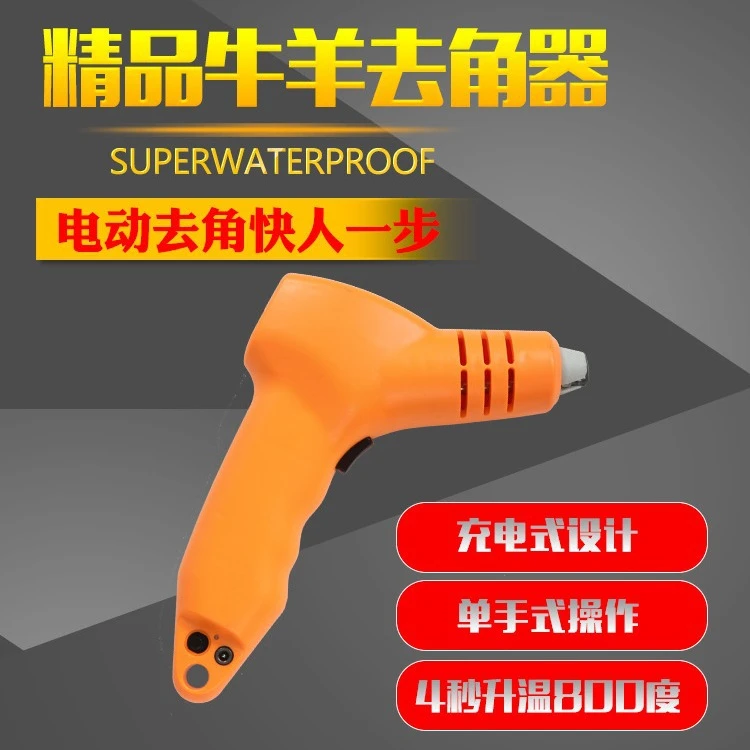
What is the E7E rechargeable cattle and sheep dehorner?What rechargeable operation and one-handed operation mean for concentrated dehorning
The E7E rechargeable cattle and sheep dehorner is a dehorner under the Linher brand, model E7E, classified in the dehorner category of livestock farming equipment, used for dehorning cattle and sheep on farms. Putting it back into the window period of concentrated dehorning, what is truly worth paying attention to is not the two words "rechargeable" and "one-handed" themselves, but the way they change the manpower arrangement at the work site.
What operating organization conditions does the rechargeable power supply method change?
Concentrated dehorning often involves handling multiple animals in a short period of time, and the work point may not be in a fixed pen, and may also be far from a stable power source. Rechargeable power supply means the tool does not have to be tied to one position by a power cord, and the work station can follow the animals and follow the hands. For the organizer, this brings two direct changes: first, the work sequence can be flexibly adjusted according to the animals' arrival situation, without disrupting the batch order to accommodate the socket;Second, "charging preparation" can be arranged separately as a pre-shift item, rather than waiting for power in the middle of the work.
It should be noted that cordless does not mean unlimited continuous operation. Battery life, charging time, and whether a spare battery pack is needed all directly affect how many head can be scheduled in a day, and these are conditions that must be confirmed with the product supplier before purchase.
The one-handed operation design corresponds to single-person coordination, not omitting restraint.
The practical significance of the one-handed operation design is to free up one of the operator's hands to assist with animal restraint and tool positioning, thereby supporting the division of labor of "one person as the main operator, one person or one set of facilities responsible for restraint." What it reduces is the coordination difficulty during operation, not a reason to eliminate restraint. Dehorning work involves animal stress and personal safety, and the restraint step should still be carried out according to the farm's existing restraint specifications.
In other words, this design helps free up part of the manpower from "requiring two people to work closely together throughout," but the premise is that the restraint method itself is reliable. If you rely on manual force to press down hard, one-handed operation may actually make your hands even more tense.
To judge whether this device fits your window period, you can first confirm three things: whether the work point is frequently moved, how many head are expected to be handled per shift, and whether the existing restraint method allows the operator to reliably free up one hand. Once these three points are clear, it makes sense to then discuss battery matching and spare parts;If they are not clear, it is recommended to tell the current website team your specific working conditions and let them help determine a matching solution.
During a concentrated dehorning window period, how should the work order be arranged so as not to delay feeding?Organize it in three stages: before, during, and after the work
The place where concentrated dehorning is most likely to go wrong is not the tool itself, but the work order colliding with feeding times: animals are fed right after being handled, so feeding and wound observation interfere with each other;Or people are busy catching cattle first, the tool is out of power, the blade has not been changed, and the whole batch of work is delayed until after feeding time. Splitting the window period into three segments—before, during, and after the operation—for scheduling is more stable than on-site ad-hoc dispatching.
Before the operation: animal grouping, tool positioning, and charging arrangements
One day in advance, divide the animals to be handled into small batches by age, body size, and pen, with each batch limited to a number that personnel can complete before feeding, avoiding driving too many cattle at once and causing prolonged standing and stress. At the same time, fully charge the E7E rechargeable cattle and sheep dehorner and spare batteries, and confirm that battery rotation is sufficient according to the number of operation points—the advantage of rechargeable tools is getting rid of external power sources, but the premise is that the batteries are full before leaving. Tools, disinfection supplies, and record sheets are laid out all at once at a fixed workstation to reduce back-and-forth fetching during the process.
Schedule the operation period to be completed before feeding as much as possible, leaving a buffer between handling and feed delivery for the animals.
During and after the operation: restraint, rotation, wound observation, and staggered feeding
During the operation, proceed one animal at a time in the rhythm of "restrain—operate—record—return"; the division of labor with one person restraining and one person operating is more stable than one person struggling alone;The E7E's one-handed operation design reduces the coordination burden on the operator's other hand, but animal restraint must still be carried out according to on-site regulations and cannot be skipped just because the tool is convenient. Batteries are rotated by batch, and they are swapped out for charging before the power drops, avoiding mid-task waiting.
Do not feed immediately after the operation. First let the treated animals be briefly observed in a clean pen, focusing on whether there is abnormal bleeding from the wound and whether the animals stand and raise their heads normally; handle and record any abnormalities promptly. Shift feeding time overall later or stagger it from untreated batches, and wait until the animals' condition is stable before feeding.
With this arrangement, the dehorning window period and feeding each follow their own rhythm and will not hold each other back.
If the number of animals on site is large and the operation points are scattered, you need to first confirm the matching relationship between the number of batteries and the daily processing batches. You can explain the pen layout and average daily processing volume to the Linher team, and then determine the supporting plan.
How should personnel be assigned when there is not enough manpower?Matching judgment for single-person operation and two-person cooperation
During the concentrated dehorning window when manpower is tight, the core of division of labor is not "the more people, the better," but whether the step of securing the animal can be reliably handled. The E7E adopts rechargeable power supply and a one-handed operation design, which determines its different position under the two organizational approaches.
Single-person operation: what the one-handed operation design can alleviate and what it cannot replace
The one-handed operation design alleviates the coordination burden of "one hand securing, one hand operating"—the rechargeable power supply also eliminates the steps of dragging cords and finding a power source, so the work point can follow the cattle pen. But it must be made clear: it cannot replace animal restraint. During single-person operation, restraint (neck clamp, restraint frame, or reliable auxiliary constraint) must still be in place in advance, otherwise the freed-up hand is meaningless.
If you plan to work alone when manpower is insufficient, first confirm three things: whether the restraint facility allows each animal to enter and exit quickly, whether tools can be picked up and placed nearby at the work point, and whether the pace of single-animal operation allows pauses midway. If any one of these cannot be achieved, the labor-saving advantage of single-person operation will be offset.
Two-person cooperation and rotation: how to share the time-window pressure of concentrated batch operations
Two-person cooperation is better suited to concentrated batch processing: one person handles restraint and animal handover, while the other operates the E7E, with roles swapped by batch to avoid the same person repeating the same movements for a long time. It is recommended that the trigger point for rotation be based on "completing one batch" rather than a fixed clock time, so that the rhythm follows the animals. It should be noted that the value of a two-person setup lies in reducing waiting and handover gaps. If the restraint step itself cannot keep up, adding another person will not shorten the window period—in this case, restraint throughput should be addressed first rather than adding more operators.
How to determine which type you belong to:
- Reliable restraint facilities, short per-animal handling time, and small batch size → single-person operation is feasible, with the focus on keeping tools within easy reach.
- Restraint requires manual holding, large differences in animal body size, and concentrated batches → two-person cooperation plus rotation is more stable.
- If both are tight → first fix the dehorning step, then talk about headcount.
Whether the E7E's battery life and charging setup can cover your continuous workload for one window period depends on your batch size and per-head time; this needs to be confirmed with the Linher team after you explain your daily head count.
Is the E7E cordless dehorner right for your farm?Who it's recommended for, who it isn't, and budget boundaries
Recommended and not-recommended scenario boundaries: how it compares with gas-powered and manual dehorning pliers
To judge whether to choose the E7E, first look at where the bottleneck is during the window period. Short on staff, short on stable power, and work sites need to move, cordless is the better fit;Only dealing with a few sporadic animals and with an extremely tight budget, manual dehorning pliers are sufficient;For single-point fixed operations and the pursuit of continuous high temperatures, gas-powered models still have their place. The E7E's charging power supply and one-handed operation design simultaneously relax the two constraints of "energy" and "manpower," at the cost of being constrained by battery life and charging arrangements; continuous large-batch operations require advance planning for rotation.
Scenarios not recommended include: handling only a very small number of animals per year, where the cost of idle tools exceeds the convenience benefit;On-site conditions where animal restraint cannot be more reliably ensured—rechargeable tools will not replace restraint standards;When the procurement goal itself is not clearly defined (whether to solve manpower, power supply, or consistency of results), switching equipment at this point only pushes the problem down the road.
Budget and procurement judgment: what to confirm first before deciding whether to replace
The recommended budget priority order is:Matching the number of devices with the work batch size → whether the battery and charging setup can cover the pace of mobile work → spare blades and staff training。 The first two determine whether the tool can actually be put to use, and the latter two determine whether its use is stable. The price range, actual battery runtime, and after-sales and spare parts policies are not provided in the existing materials. Procurement calculations should be made only after confirming with the Linher team, and in particular it is necessary to ask clearly whether battery rotation is sufficient within one window period and how the blade replacement cycle is calculated.
The product materials state that the applicable subject is cattle. Whether use on sheep falls within the scope of adaptation also needs to be confirmed with the supplier; do not assume on your own that it is "universal for cattle and sheep."
Frequently asked questions
After the E7E rechargeable cattle and sheep dehorner is fully charged, how many head can it process continuously?
The number of heads that can be handled per single charge depends on animal size, handling time per head, and battery condition; the available information does not provide a fixed value.It is recommended that before purchasing, you explain your average daily throughput and the number of work sites to the Tianji team, so they can help determine how many batteries are needed in rotation to cover one window period.
On the day of concentrated dehorning, how should feeding times be adjusted?
It is recommended to complete dehorning work before feeding. After treatment, let the animals be briefly observed in a clean pen to confirm there is no abnormal bleeding from the wounds and that the animals can stand and raise their heads normally. Then shift the feeding time as a whole later or stagger it from untreated batches, so that feeding and wound observation do not interfere with each other.
Can one person operate the E7E to complete dehorning?
Under conditions where the restraint facility is reliable, handling time per head is short, and the batch size is not large, single-person operation is feasible. The one-handed operation design can ease the coordination burden of fixing with one hand and operating with the other.However, the restraint step still needs to be in place in advance; tools cannot replace animal restraint.If restraint requires manual holding or there are large differences in animal size, two-person cooperation with rotation is more reliable.
Can the E7E rechargeable dehorner be used on sheep?
The product documentation states that the intended target is cattle; whether use on sheep falls within the scope of suitability needs to be confirmed with the Tianji team, and it is not recommended to assume on your own that it is "suitable for both cattle and sheep."
How should one choose among rechargeable dehorners, gas-powered dehorners, and manual dehorning shears?
Look at the bottleneck during the window period: if work points move, there is no stable power supply, and manpower is tight, the rechargeable type is more suitable;if only a few head are handled sporadically and the budget is very tight, manual dehorning shears are sufficient;for fixed single-point operation and pursuit of continuous high temperature, the gas-powered type still has its place.The trade-off of the E7E is that it is constrained by battery life and charging arrangements, so continuous large-batch operation requires planning rotation in advance.
Learn more
If your farm is scheduling a centralized dehorning window, you can send the Tianji team information such as the number of heads processed per day, pen layout, existing restraint methods, and whether the work point is mobile. We will combine the E7E's battery configuration and personnel division logic to help you determine whether this solution matches your work rhythm.